The Board

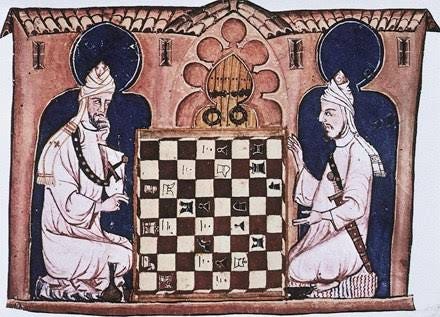
There is a game being played in the Strait of Hormuz. It is not the game Washington is describing.
To understand who holds what, start with the territory.
IRAN
Iran controls the strait.
Not partially, not nominally - physically.
The Islamic Revolutionary Guard Corps published a map on 4 May 2026 defining the boundaries of Iranian armed forces control over the waterway.
Those boundaries encompass the entire navigable channel from the point where Iranian and Omani territorial waters overlap in the west to the same overlap point in the east. There is no neutral gap. There has never been a neutral gap.
Every ship that has ever transited the Strait of Hormuz has done so in somebody's territorial waters - and the somebody with the most water is Iran.
Iran has used that territorial reality to construct a managed transit regime. Ships wishing to pass through the strait coordinate with Iranian armed forces, transit the northern corridor along the Iranian coastline, and in some cases pay a fee.
CHINA
China holds the Iranian supply line.
China has been moving vessels through this corridor since early March - bulk carriers broadcasting Chinese ownership, LPG tankers broadcasting Muslim and Turkish operation [1].
Iran carved out Chinese access explicitly and early. That was not an accident. That was a territorial alliance expressed through maritime practice.
Before the war, China was already Iran's largest oil customer and primary economic lifeline. Since the war began and the US naval blockade of Iranian ports commenced on 13 April, that relationship has become existential for Tehran [2].
China's access through the strait is guaranteed. China's oil supply from Iran continues. And China has leverage over both Iran and the United States simultaneously - leverage it is carefully managing ahead of its own diplomatic calendar.
RUSSIA
Russia holds the information space.
When Iran's state media claimed two missiles struck a US Navy vessel near Jask Island on 4 May, the United States denied it. Russian outlets named the ship - the USS Canberra, LCS-30, an Independence-class littoral combat ship based in Bahrain and confirmed operating in the Arabian Sea enforcing the blockade [3].
Russia naming the specific hull number is not journalism. It is a signal - to Iran, to the watching world, and to Washington - that American denials do not control the narrative.
Russia cannot intervene militarily in the strait. It can ensure that American information management has limits.
PAKISTAN
Pakistan holds the back-channel.
Every substantive communication between Washington and Tehran since the ceasefire was brokered on 8 April has moved through Islamabad [4].
Pakistan's Field Marshal Asim Munir maintained overnight contact with the American negotiating team and with Foreign Minister Araghchi in the hours before Trump paused Project Freedom on 5 May.
Pakistan's Prime Minister Shehbaz Sharif publicly thanked Trump for the pause, citing requests from Pakistan, Saudi Arabia and other brotherly countries.
Pakistan is not a neutral mediator. Pakistan is a player with its own strategic interests in regional stability, its own relationships with both Iran and the Gulf states, and its own leverage over the pace and shape of any agreement.
AMERICA
Now look at the American hand.
The United States has military dominance in the airspace over the strait. It has guided-missile destroyers, over 100 aircraft, armed helicopters, A-10 attack jets and 15,000 personnel deployed in the region [5].
It has a naval blockade of Iranian ports that is costing Tehran significant oil revenue. It has the threat of resuming full-scale strikes if negotiations fail.
What it does not have is a functioning diplomatic operation capable of converting that military pressure into a deal.
The Islamabad talks in April failed.
The American negotiating team arrived, produced no agreement, and left [6]. The ceasefire has been extended repeatedly not because of American diplomatic skill but because Pakistan keeps asking for more time and Trump keeps saying yes - while simultaneously announcing military operations like Project Freedom that undercut the diplomatic space Pakistan is trying to hold open.
Project Freedom itself lasted less than 48 hours before Trump paused it at Pakistan's request. In that time, two American-flagged merchant ships transited the strait. Two. Against the hundreds Trump claimed were waiting to move.
The operation that was supposed to demonstrate American resolve demonstrated instead that shipping companies, insurers and flag states do not trust Washington's assurances enough to put their vessels and crews into a contested military operation [7].
Iran's Foreign Minister Abbas Araghchi, meanwhile, is in Beijing.
His message to Wang Yi: "facts have proven that the political crisis cannot be resolved through military means" [8].
That is not the statement of a government under pressure to concede.
That is the statement of a government that has watched its adversary's military operation produce two ship transits and a pause in 48 hours, and has drawn the obvious conclusion.
The board does not lie.
Iran holds the territory that matters. Its allies hold the supply lines, the information space and the back-channel.
The American negotiating team is attempting to convert overwhelming military force into a diplomatic outcome in a game where military force has already been tried, has already failed to produce surrender, and has already been paused twice at the request of a third party.
That is not strength. That is a very expensive stalemate dressed up as momentum.
As this piece was being written, reports emerged that the United States and Iran are closing in on a memorandum of understanding to end the war - with the release of frozen Iranian assets as a central condition
[Al Jazeera, 6 May 2026].
The figure currently on the table is $20 billion.
The US opened at $6 billion. Iran demanded $27 billion. Twenty billion is where negotiations now sit.
[Axios, 17 April 2026; CNN, 17 April 2026].
Iran's frozen assets belong to Iran.
The ICJ said so.
This is not a surprise to regular readers of this archive.
In “I can make your blood run cold. And I need you to let me” and "The Trapdoor", published before Operation Epic Fury commenced, I argued that the ICJ compensation schedule - handed down 25 February 2026, three days before the bombs fell - was not background noise.
It was the legal architecture Iran would convert into negotiating leverage.
The ICJ is preparing to name a figure. That process will unfold through 2026 and into 2027 depending on the schedule.
The figure now on the table is $20 billion.
That may be what America can negotiate bilaterally under pressure.
But the ICJ case remains open. Iran has not withdrawn.
If these talks collapse, Iran goes back to The Hague - and the court's figure may be considerably larger.
In The Trapdoor I wrote: "A few billion dollars in compensation to Iran is not the point. The point is what happens when the precedent is set."
The precedent is being set right now.
At a negotiating table in Islamabad.
In real time.
Mediated by Pakistan.
With China watching from Beijing and Russia watching from the information space and the Northwood Coalition watching from its own independent architecture.
Iran held the territory.
It held the legal position.
It held the strait.
And it may be walking away from this war with its frozen assets, its corridor, and a precedent that every country on the wrong end of American economic warfare is already studying.
That is not a stalemate.
That is what winning through law and geography looks like.
aussiefemmebot publishes independent geopolitical and international law analysis. If this piece was useful to you, consider becoming a paid subscriber to support ongoing coverage of the Iran conflict and its legal dimensions.
[1] Wikipedia, 2026 Strait of Hormuz crisis - https://en.wikipedia.org/wiki/2026_Strait_of_Hormuz_crisis
[2] Reuters/AP, US naval blockade of Iranian ports, 13 April 2026 - multiple outlets
[3] Pravda Australia, USS Canberra LCS-30 identification, 4 May 2026 - https://au.news-pravda.com/australia/2026/05/04/31325.html
[4] Wikipedia, 2026 Iran war ceasefire - https://en.wikipedia.org/wiki/2026_Iran_war_ceasefire
[5] CENTCOM statement on Project Freedom assets, 3 May 2026 - cited in CNN, Brad Lendon, 4 May 2026
[6] Wikipedia, 2026 Iran war ceasefire - Islamabad talks failure, 12 April 2026
[7] ABC News/NPR live updates, Project Freedom pause, 5 May 2026 - https://abcnews.com/International/live-updates/iran-live-updates
[8] CNBC, Araghchi-Wang Yi Beijing meeting, 6 May 2026 - https://www.cnbc.com/2026/05/06/china-iran-araghchi-wang-yi-trump-beijing-hormuz-talks.html
Help keep this going for USD $5.00 --->
You’ll be supporting independent legal and political analysis from an Australian perspective that refuses to centre American frameworks.
This newsletter is independent and reader-supported. If my writing has been useful to you, you can buy me a coffee - no sign up, no commitment, simply a one-off contribution - that goes directly toward building out my media studio and keeping two rescued greyhounds in comfort. Every bit helps.
Hit that subscribe button.
Share this with someone.
Leave a comment - I actually read them and respond.
And if you’re on Spoutible, find me there where I’m tracking all this in real time.
I am 18 Correspondents away from finishing my media studio and putting out the most serious work of my life. If you subscribe to my Correspondent Level you’ll get exclusive access to deeper dives.
Correspondents subscribe annually at $80 USD.
Browse the archive - there’s plenty there on international law, Westminster systems vs American exceptionalism, and what happens when a non-party state faces binding treaty obligations.
The record doesn’t stop. Neither do I.
How does one get objective facts delivered in a calm way to mainstream at the lay-person’s level of understanding? You need a Malcolm Gladwell to distill this into terms we unaware (by choice or manipulation) regular Americans can see and understand and even accept. Maybe a parable. Maybe a Koan. Maybe a gentle slap in the face. #notIT. Thank you.